
Maintaining high quality standards is crucial for any company seeking to remain competitive. Companies that manage to deliver consistent quality throughout their operations not only build stronger relationships with their customers, but also set themselves up for long-term growth and profitability.
However, improving quality within a company requires a strategic approach. In this blog, we present four essential steps to help you raise quality standards in your organization.Table of Contents
1. Evaluate current processes and identify gaps
 The first step in improving quality in any company is to conduct a thorough assessment of current processes. This analysis helps to understand where gaps exist between the company’s current performance and its desired quality objectives.
Some key questions to ask during this assessment phase include:
The first step in improving quality in any company is to conduct a thorough assessment of current processes. This analysis helps to understand where gaps exist between the company’s current performance and its desired quality objectives.
Some key questions to ask during this assessment phase include:
- Are there frequent customer complaints about specific products or services?
- Is there a lack of consistency in results across different teams or departments?
- Are employees following documented procedures correctly?
2. Establish measurable quality objectives
Once the gaps have been identified, it is time to set clear quality objectives that align with the company’s goals. These objectives should be specific, realistic and measurable over time, focusing on areas such as reducing defects, improving turnaround times and increasing customer satisfaction. It is important that everyone involved, from management to front-line workers, understand these objectives. Clear communication helps align efforts and ensures that employees know what they are working toward. Some quality objectives may include:- Reduce product defect rates by 10% in six months.
- Increase customer satisfaction ratings by 15% over the next quarter.
- Speed production time by 20% through process improvements.
3. Implement a continuous improvement framework
Improving a company’s Quality Management System is not a one-time effort; it is an ongoing process that requires a commitment to continuous improvement. Implementing a continuous improvement framework, such as Plan-Do-Check-Act (PHVA), can help guide efforts to realize better quality improvements.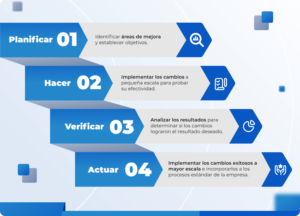
This structured approach ensures that the company constantly adapts to new challenges and opportunities, keeping quality as a priority in its operations.
💡 You might also like: ISO 9001 for SMEs: a complete step-by-step guide for implementation
4. Fostering a culture of quality
No quality improvement initiative will succeed unless there is a widespread commitment within the company to achieve high standards. This involves providing regular training, encouraging employee feedback and creating open channels of communication to address quality issues as they arise. Quality-focused companies understand that each team member plays a crucial role in maintaining their standards. When employees feel empowered to take responsibility for quality in their daily work, the entire company benefits, with reduced errors and increased productivity.Read more: Reliable quality management systems? How to choose a good supplier
In summary, quality in a company requires a holistic approach that encompasses both processes and people. By assessing current workflows, setting measurable goals, implementing continuous improvement strategies and fostering a culture of quality, companies can achieve lasting improvements in their operations. QualityWeb 360 is designed to simplify and improve your quality management processes. With its intuitive interface and powerful tools, it helps companies streamline workflows, track performance and ensure compliance with industry standards. Would you like to know how other companies have done it? We invite you to explore the video “Más Metrología’s Quality Management System Success Story.” You’ll find the steps they followed to achieve optimal document control and its tangible benefits.