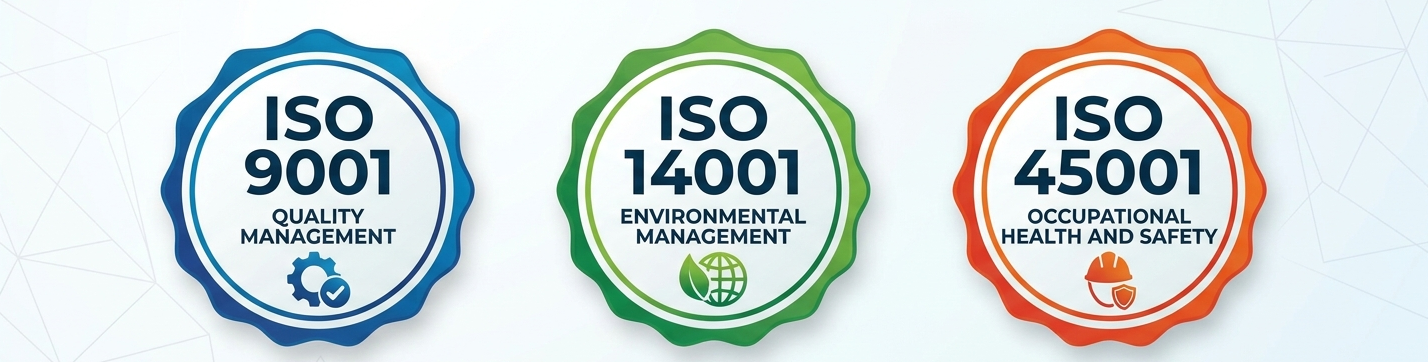
If your company works with quality, environment and occupational safety, you have probably heard of ISO 9001, ISO 14001 and ISO 45001. All three are international management system standards, and although they share a common structure, each serves a different purpose. Understanding their differences – and how they can work together – is key for any organization seeking operational excellence.
In this article we explain how these three ISO standards differ and how you can integrate them into a single, efficient management system.
Table of Contents
What is ISO 9001 and what does it manage?
ISO 9001 is the international standard for Quality Management Systems (QMS). Its objective is to ensure that an organization delivers products and services that meet customer requirements and comply with applicable regulations.
The fundamental pillars of ISO 9001 are:
- Customer focus
- Leadership and planning
- Process control
- Continuous improvement
The current version is ISO 9001:2015, which introduced risk-based thinking and greater alignment with other ISO standards thanks to the High Level Structure (HLS).
Who needs it? Any organization that wants to demonstrate its ability to consistently deliver quality products and services, regardless of size or sector.
What is ISO 14001 and what does it manage?
ISO 14001 is the standard for Environmental Management Systems (EMS). Its focus is on helping organizations minimize their impact on the environment, comply with applicable environmental legislation and continually improve their environmental performance.
Key aspects of ISO 14001 include:
- Identification of environmental aspects and impacts
- Legal and regulatory compliance
- Measurable environmental objectives
- Communication and staff awareness
The current version is ISO 14001:2015, also aligned with the High Level Structure.
Who needs it? Companies with operations that generate significant environmental impact, organizations operating in regulated sectors, or those that want to demonstrate commitment to sustainability to their stakeholders.
What is ISO 45001 and what does it manage?
ISO 45001 is the international standard for Occupational Health and Safety Management Systems (OSH). It replaced OHSAS 18001 in 2018 and aims to provide safe and healthy working conditions to prevent injuries, occupational diseases and fatalities.
Its essential elements are:
- Identification of hazards and evaluation of occupational risks
- Worker participation and consultation
- Incident investigation
- Compliance with OSH legislation
The current version is ISO 45001:2018.
Who needs it? Any organization wishing to proactively manage the safety and health of its workers, especially those with risky activities or subject to strict labor regulations.

Comparison chart: ISO 9001 vs ISO 14001 vs ISO 45001
| Feature | ISO 9001:2015 | ISO 14001:2015 | ISO 45001:2018 |
|---|---|---|---|
| Management area | Quality | Environment | Occupational health and safety |
| Main focus | Customer satisfaction | Environmental impact | Accident prevention |
| Structure | High Level (HLS) | High Level (HLS) | High Level (HLS) |
| Key Stakeholders | Customers | Society and regulators | Employees |
| Typical indicators | Defects, returns | Emissions, waste | Accident rate, absenteeism |
| Certification | Mandatory for many sectors | Voluntary / required in tenders | Mandatory in risk sectors |
What do the three standards have in common?
Despite their differences, ISO 9001, ISO 14001 and ISO 45001 share an identical structural basis: the High Level Structure (HLS), also known as Annex SL. This means that all three standards are organized into the same 10 chapters:
- Purpose and scope
- Normative references
- Terms and definitions
- Context of the organization
- Leadership
- Planning
- Support
- Operation
- Performance Evaluation
- Improvement
This common structure is precisely what makes the integration of the three systems possible – and advisable.
How to integrate ISO 9001, ISO 14001 and ISO 45001?
Integrating the three systems into an Integrated Management System (IMS) is the most efficient strategy for organizations operating under all three standards. Instead of maintaining three separate systems with their own documentation, audits and resources, the IMS unifies all common elements into a single structure.
Advantages of integration
- Cost reduction: fewer duplicate audits, unified documentation and reduced administrative burden.
- Better strategic alignment: quality, environmental and safety objectives are planned consistently.
- Increased operational efficiency: processes are designed only once considering all three systems.
- Combined audits: certifiers offer integrated audits that reduce operational downtime.
- Stronger organizational culture: when workers understand that quality, environment and safety are a whole, greater commitment is generated.
Steps to implement an integrated management system
Initial diagnosis: Evaluate the current status of each system (if you already have one in place) and identify common elements and gaps with respect to the three standards.
2. Define the scope of the IMS: Determine which units, processes and locations fall within the integrated system.
Map common processes: Identify processes that impact quality, environment and safety simultaneously (e.g., supplier management, personnel training, incident management).
4. Unify documentation: Create an integrated policy that addresses all three commitments, an IMS manual (if deemed necessary) and single procedures where requirements are common.
5. Training and awareness: Staff must understand the requirements of the three systems and how they affect their job.
6. Integrated internal audits: Design the internal audit program to cover all three systems in a coordinated manner.
7. Management review: Top management should review IMS performance jointly, analyzing quality, environmental and safety indicators at the same meeting.
8. Certification: Apply to an accredited certification body for a combined certification audit for all three standards.
Common mistakes when integrating the three systems
Many organizations make the same mistakes when trying to integrate ISO 9001, ISO 14001 and ISO 45001:
- Maintaining three separate teams instead of one integrated management team with clear responsibilities.
- Redundant documentation: creating three versions of the same procedure when one well-written one can cover all three systems.
- Failure to involve top management from the start, leading to lack of resources and support.
- Ignoring real differences: integration does not mean that everything is the same; each standard has specific requirements that must be managed correctly.
- Precipitating certification without having matured the integrated system internally.
Why implement the three standards in your company?
Operating under an Integrated Management System that includes ISO 9001, ISO 14001 and ISO 45001 positions your company as a mature, responsible and excellence-oriented organization. The advantages go beyond regulatory compliance:
- Greater competitiveness in public and private tenders that require certification.
- Better corporate image before clients, suppliers and investors.
- Reduction of legal, operational and reputational risks.
- Solid basis for implementing other management systems (ISO 50001, ISO 27001, etc.).
Conclusion
ISO 9001, ISO 14001 and ISO 45001 address three fundamental dimensions of business management: quality, environment and occupational safety. Although each has its own approach, their common structure makes them perfectly integrable into a single system that saves resources, reduces duplication and generates a more robust organizational culture.
If your company is evaluating implementing one or more of these standards, the smartest step is to plan from the beginning with an integrated vision. At QualityWeb 360 we can help you achieve this.
 Frequently Asked Questions
What is the main difference between ISO 9001, ISO 14001 and ISO 45001?
ISO 9001 manages the quality of products and services, ISO 14001 focuses on reducing the environmental impact of the organization, and ISO 45001 focuses on preventing accidents and occupational diseases. All three share the same High Level Structure (HLS), which facilitates their integration into a single Management System.
Can a company be certified to all three standards at the same time?
Yes, in fact, it is recommended. Accredited certification bodies offer combined audits that assess ISO 9001, ISO 14001 and ISO 45001 in a single visit, reducing costs and operational downtime. To do so, the company must have an Integrated Management System (IMS) in place.
Is ISO 14001 and ISO 45001 certification mandatory?
It depends on the sector and the country. ISO 14001 is usually required in public tenders and in companies with high environmental impact. ISO 45001 is mandatory in risk sectors in many countries, although in others it is voluntary. ISO 9001, on the other hand, is a requirement in many contracts with customers and supply chains.
💡 You might also like: Key requirements for ISO 9001 certification