

Table of Contents
Why nonconformance response time matters more than you think
ISO 9001:2015 does not define a maximum response time for closing a nonconformity, but it does require that corrective actions be timely and proportional to the magnitude of the problem (clause 10.2). In practice, a slow system generates three specific problems:- The problem reoccurs. If corrective action is delayed for weeks, the root cause is likely to remain active and the NC is likely to recur before it is closed.
- Internal audit finds the history fragmented. Without traceability, the auditor cannot verify whether the action was effective.
- The team loses confidence in the system. When NCs remain open with no visible movement, the perception is that the QMS is not working.
Where time is wasted: the most frequent bottlenecks
Before talking about solutions, it’s worth being specific about where the process breaks down. In most SMEs that use Excel or email to manage nonconformances, the bottlenecks are predictable: Detection → Recording: sometimes days pass between someone identifying a problem and formally documenting it. Without a clear reporting channel, the NC remains in the verbal realm. Assignment → Acceptance: The quality manager assigns the NC by mail, but there is no confirmation that the assignee received it, understood it, or accepted it. This limbo can last for days. Root cause analysis → Action plan: This is usually the longest step. Without a structure to guide the analysis (5 whys, Ishikawa, etc.), the manager procrastinates because he/she does not know where to start. Execution → Closure: Actions are executed but no one documents them. When the time comes to close the NC, the history has to be rebuilt from scratch. Each of these gaps is lost response time. And together, they easily add up to weeks.How digital workflows work to manage NCs
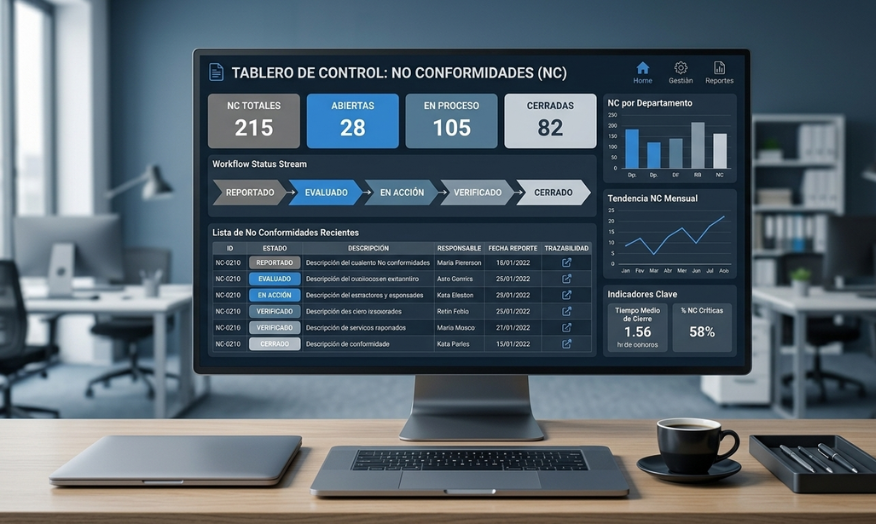
A digital nonconformance flow is not magic – it is a standard process converted into sequential steps with visible responsible parties, deadlines and statuses. The goal is that no one has to ask “where did that NC go?” because the system shows it in real time. A typical ISO 9001 NC workflow flow has these stages:| Stage | What happens | What the system provides |
|---|---|---|
| Detection and recording | Document the problem, origin, area | Standard form, automatic date and user logging |
| Root cause analysis | Causes are identified with structured methodology | Guided templates (5 Whys, Ishikawa) integrated |
| Corrective action plan | Actions, responsible parties and dates are defined | Assignment with automatic notification to responsible party |
| Execution and follow-up | Actions are executed and documented | Status update, reminders by due date |
| Effectiveness verification | Assessment of whether the problem has actually been solved | Closing criteria defined, approval of the responsible person |
| Closure and archiving | Close NC with complete history | Traceable record, available for audits |
Criteria for automating corrective action without losing control
Automating doesn’t mean that the system makes decisions for the team. It means that the administrative tasks – notifying, reminding, escalating, filing – are done by the system; and the analysis and decision tasks are still done by the person. When evaluating how to digitize the flow of corrective actions, consider these criteria:- Automatic notification to the assignee. When an NC is created and assigned, the responsible party should receive an immediate alert with the problem detail and expected timeframe. Eliminates the manual “notify by mail” step.
- Follow-up by due date. The system should identify which NCs are about to expire or have already expired, and automatically escalate to the appropriate person. This prevents NCs from simply being “forgotten”.
- Traceable history without extra effort. Every status change, comment or action taken should be automatically recorded. The history should be a consequence of the work, not an additional step.
- Integration with the nonconformance module. The corrective action flow cannot live separately from the original NC record. Traceability depends on the two being connected.
- Access control by role. The operator reporting the NC does not need to see the system statistics. The quality manager needs to see the full dashboard. Permissions should reflect how the team works.
Metrics for measuring nonconformity efficiency
Once you have the flow digitized, you need to measure if it is really working. The most useful metrics for NC workflow in an ISO 9001 system are: Average Turnaround Time (TTR): days between detection of the NC and implementation of the first corrective action. A TTR of less than 5 working days is a reasonable target for most SMEs. On-time closure rate: Percentage of NCs closed within the committed timeframe. A rate below 70% indicates structural problems in assignment or workload. Recurrence rate: Percentage of NCs that are reopened or correspond to the same root cause as a previous NC. If this rate exceeds 20%, the root cause analysis is not working. Open NCs by area: Distribution of open nonconformities by department or process. Identifies where systemic problems are concentrated. These indicators should be available in real time – not in a report that someone generates once a month. That’s what having the data in a digital system is for: the information is there, ready when you need it, especially before an internal audit. If your team has been looking for a way to streamline this process for some time, QualityWeb 360 has a digitized NC flow with integrated assignment, tracking and closure – no complex setup or configuration.
Frequently Asked Questions
How long does it take to implement a digital nonconformity flow?
It depends on the system you use. With a SaaS platform configured for ISO 9001, the basic flow can be operational in less than a week. What takes longer is not the technical setup, but aligning the team on how to use the process: who reports, who analyzes, who closes.Is it mandatory to digitize nonconformity management to comply with ISO 9001?
No. ISO 9001:2015 does not require any specific software. You can comply with the standard using paper documents, spreadsheets or digital tools. The difference is practical: above a certain volume of NCs or frequency of audits, a manual system becomes difficult to maintain with the traceability required by the standard.What if corrective action does not solve the problem?
ISO 9001 addresses exactly that scenario in clause 10.2.1e: if the action taken was not effective, you must update the assessed risks and take new action. A digital flow that includes an effectiveness verification stage – with defined criteria and explicit approval – makes it easier to detect these cases before closing the NC.What minimum information should the record of a nonconformity contain?
At a minimum: description of the problem, origin (process, area, source), date of detection, assigned responsible, root cause analysis, defined actions with dates, and evidence of closure. If the system asks you to fill all this in the same record, the history will be complete without extra work.Is the flow different for internal and external nonconformities?
The scheme is the same, but the origin and parties involved change. An internal audit NC usually has a closure deadline defined by the audit plan. A customer NC has additional implications on communication and satisfaction indicators. The digital flow can use the same base process with additional fields depending on the type.Read also: ISO 9001 nonconformities: types and how to manage them.