

Are you tired of losing customers due to inconsistent product or service quality? Or, maybe you’re struggling to keep up with increasing competition?
In today’s competitive business landscape, maintaining high-quality standards is crucial for success. Quality Management Systems (QMS) provide a structured approach to managing and improving quality across all areas of an organization.
Understanding and implementing a Quality Management System is an essential step towards achieving excellence and gaining a competitive edge. In this blog, we will provide you with more information on the topic, so continue reading.
Table of contents
What are Quality Management Systems?
A Quality Management System is a formalized framework that documents processes, procedures, and responsibilities for achieving quality policies and objectives. It helps organizations coordinate and direct activities to meet customer and regulatory requirements and improve effectiveness on a continuous basis.
💡 You might also like: ISO 9001 for SMEs: a complete step-by-step guide for implementation
How Quality Management Systems support ISO 9001 certification
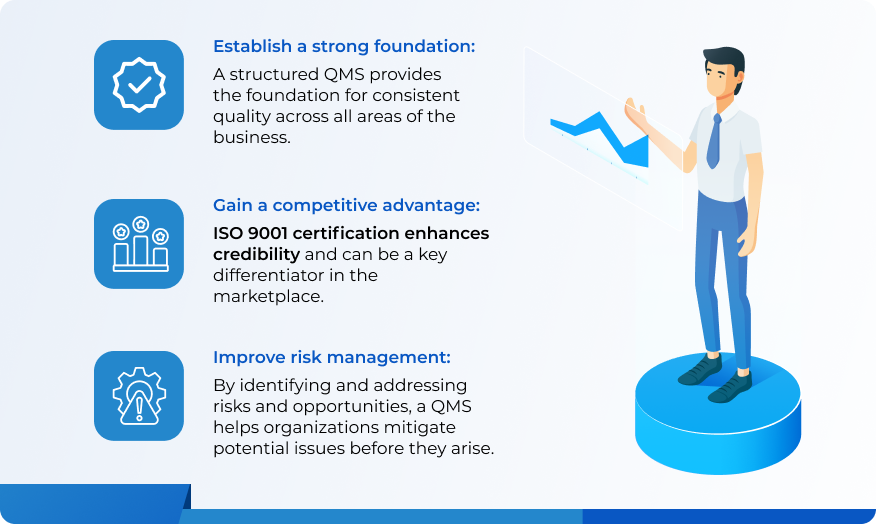
ISO 9001 is an internationally recognized standard that sets the criteria for a Quality Management System. It is based on several quality management principles, including a strong customer focus, the involvement of top management, a process approach, and continuous improvement. Implementing this normative helps organizations:
Continue reading: QMS Implementation: Key Benefits of a Quality Management System | QualityWeb360
Conclusion
As you can see, the implementation of a quality management system based on an ISO 9001 standard may seem quite challenging, but it’s something that is worthwhile for the company.
FAQ
❓ What is a Quality Management System (QMS) and why does my business need one?
A Quality Management System helps organizations standardize processes, improve efficiency, reduce errors, and ensure consistent product or service quality. It provides structure, control, and visibility across operations, enabling businesses to meet customer expectations and regulatory requirements.
❓ What are the main benefits of implementing a Quality Management System?
Key benefits include increased customer satisfaction, reduced waste and rework, improved operational efficiency, better risk management, data-driven decision-making, and greater competitiveness in the market.
❓ How does quality management software support a Quality Management System?
Quality management software automates critical processes such as document control, audits, corrective actions, and performance tracking. This simplifies compliance, reduces manual work, and helps organizations maintain continuous improvement.