
Table of Contents
The diagnosis that no one gets right at the beginning
Carlos has been an ISO 9001 consultant for 12 years. The first time he came in to diagnose a 60-person logistics company, he spent three hours asking questions, filled four pages of handwritten notes and at the end delivered a Word report with 40 observations in no order of priority. The client was overwhelmed. He didn’t know where to start. The project got off to a bad start from day one.
This pattern repeats itself more often than it seems. The initial diagnosis is the most critical moment of any QMS implementation or maintenance, and also the most improvised.
A good diagnostic is not a list of findings – it is a structured snapshot of the current state of the system, with language that the customer can understand and a prioritization that allows you to take action. If you already do ISO 9001 internal audits with your customers, the maturity diagnostic is the preliminary step that makes sense of everything that follows.

What is a QMS maturity assessment (and what is not)?
A QMS maturity assessment is a structured evaluation of the current state of an organization’s quality management system. Its purpose is to determine how developed, consistent and effective that system is – not just whether or not it is ISO 9001 compliant.
The distinction matters because:
- A compliance audit answers: does the organization meet the requirements of the standard (Yes / No / Partially).
- A maturity diagnosis answers: how well does the system operate in practice, and what is its capacity for improvement?
A system can formally comply with ISO 9001 and still be completely ineffective. The documents exist, the procedures are signed, but no one follows them. The maturity diagnosis detects that gap.
Reference: The concept of maturity in management systems is based on models such as CMMI (Capability Maturity Model Integration) and on the continuous improvement structure of ISO 9001:2015, clause 10.
The four levels of maturity you need to assess
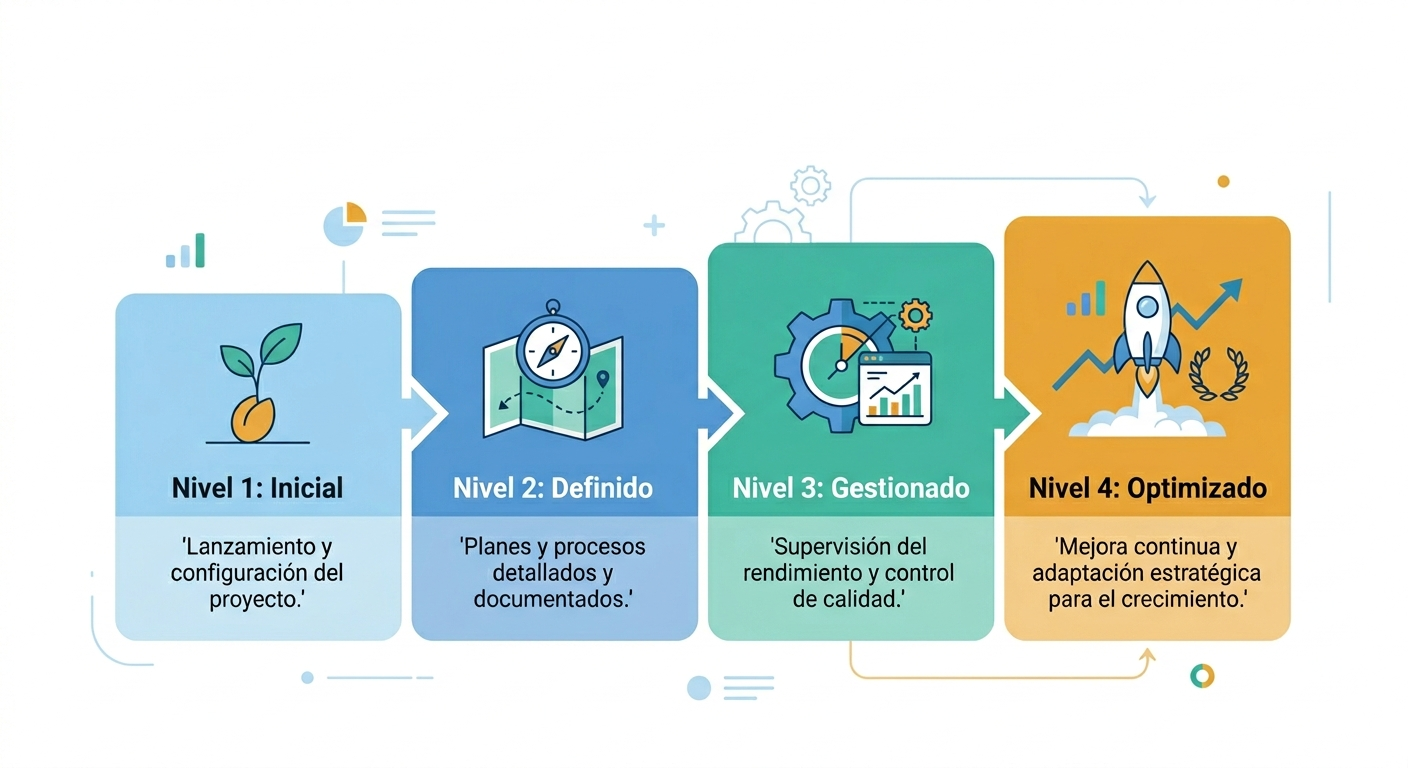
For the diagnosis to be actionable, you need a simple maturity scale that both you and the customer understand without explanation. The following four-level scale works well in an SME context:
| Level | Name | Operational Description |
|---|---|---|
| 1 | Initial / Reactive | No system defined. Action is taken when there are problems. Processes depend on people, not procedures. |
| 2 | Defined / Documented | There are written procedures, but their application is inconsistent. Quality depends on who is on duty. |
| 3 | Managed / Measured | Processes are consistently followed and measured. There are indicators, although they are not always acted upon. |
| 4 | Optimized / Continuous improvement | The system is regularly reviewed, opportunities for improvement are identified and systematically acted upon. |
How to use the scale: You evaluate each element of the QMS (document control, indicators, audits, nonconformities, etc.) with a level from 1 to 4. At the end you get a maturity profile that shows where the system is in each dimension – not a single number, but a picture per process.
That’s more honest and more useful than an overall “compliance” percentage.
Structure of the diagnostic: what to ask and how to score
A well-structured diagnosis has three parts:
Part 1: Documentary review (prior to the visit).
Ask the client before arrival:
- List of QMS documents (procedures, instructions, active records).
- Last internal audit reports (if any)
- Quality objectives for the last period
- Organizational chart and process map
With this you have a first reading of the level of formal development of the system. A customer who cannot send you any of these documents is already telling you something important.
💡 You might also like: ISO 9001 without chaos: how to automate your QMS with Artificial Intelligence
Part 2: Interviews by process (during the visit)
Don’t just interview the quality manager. Talk to at least one person from each key process: production, purchasing, customer service, management. The key questions are not “do you have a procedure for X?” but:
- “How do you know this process is working well?”
- “What happens when something goes wrong with this process?”
- “When was the last time you reviewed this procedure?”
- “Who decides when something is a nonconformance?”
The answers will tell you more than any document.
Part 3: Scoring by dimension
Evaluates each dimension of the QMS using the 4-level scale. Minimum dimensions to be covered:
| Dimension | Key questions guiding the scoring |
|---|---|
| Document control | Are documents version controlled and do they know where they are current? |
| Indicators and KPIs | Do they measure anything and do they act when the indicator fails? |
| Internal audit | Do they do it? How often? Does it generate real actions? |
| Non-conformities | Do they record NC’s? Do they analyze causes? Do they close actions? |
| Customer satisfaction | How do you know if the customer is satisfied? How often? |
| Management review | Does management formally review the QMS? With data? |
| Supplier management | Do you evaluate suppliers? with what criteria? |
Result: a table with score 1-4 per dimension + a radar chart that visually shows the maturity profile. That chart is what you present to the customer at the first meeting.

How to present the results to your client without scaring them off.
This step is where most consultants lose the client before they even start. The temptation is to deliver an exhaustive 20-page report with everything you found. The client gets it, flips through it and doesn’t know what to do with it.
An effective diagnostic presentation has this structure:
1. executive summary (1 page) Three sentences: where is the system today, what are the two or three most critical gaps, what can be accomplished in the next 90 days.
Maturity radar chart Visual, immediate, comparative. If you can show the current level vs. the target level, the better. The customer understands a chart in 10 seconds.
3. Gap prioritization (no more than 5) Rank gaps by impact and effort. A simple 2×2 table: high impact / low effort goes first. Don’t list 40 findings – that paralyzes.
4. Proposed roadmap (optional at this stage) If you already have clarity, show a 3-6 month path with concrete milestones. If not, say you define it in the next session.
What the client needs to hear coming out of that meeting: “I know where we are and what the next step is”. That’s it.
To share the maturity diagnostic with your customer in a structured way, you can use QualityWeb 360’s free QMS Maturity Diagnostic – it generates a PDF report ready to present, no need to build the report from scratch.
Frequent errors in the initial diagnosis
Diagnosing only with documents Documents show what the system says it does. Interviews and observation show what it actually does. A diagnosis without field work is incomplete.
2. Using the standard as a direct checklist Reviewing clause by clause whether it “complies or does not comply” produces a diagnosis of compliance, not maturity. The question is not “do they have the procedure” but “does the procedure work”.
If the qualitymanager is the only one involved, the diagnosis will reflect his or her vision of the system – which is usually more optimistic than reality. A 30-minute interview with the general manager completely changes the picture.
4. Delivering findings without prioritization A diagnosis with no order of importance shifts your work to the client. Your value as a consultant is in telling them what to address first and why.
5. Not defining the point of comparison Maturity against what? ISO 9001 minimum requirement? Industry best practices? The target state the client wants to achieve? Without that benchmark, maturity levels mean nothing.
Frequently Asked Questions
How long does it take to perform a QMS maturity diagnosis?
It depends on the size of the organization and the depth of the diagnosis. For an SME of 10-80 people, a complete diagnosis (document review + interviews + report) takes between 4 and 8 hours of consulting work. The on-site visit is usually 2-3 hours; the rest is analysis and report preparation.
Is it the same as a diagnostic audit?
They are used synonymously, but there is a difference in approach. A diagnostic audit usually follows the structure of the standard (clause by clause) and evaluates compliance. A maturity diagnostic evaluates effectiveness and consistency of the system in practice. The latter is more useful as a starting point for implementation or improvement.
Is the diagnosis useful for companies that are already certified?
Yes, and it is especially useful in those cases. Many companies maintain certification without the QMS adding real value to the business. A maturity diagnostic identifies that gap – the difference between complying with the standard and having a system that actually improves the operation.
What tools do I need to do the diagnosis?
The minimum: a structured question guide, a defined scoring scale and a report template. With that you can make a professional diagnosis. Digital tools help to speed up the process and generate the report automatically, but they are not indispensable at the first stage.
How often should the maturity diagnosis be done?
At the beginning of any QMS implementation or improvement project, and then annually as part of the system review. Some consultants integrate it as a deliverable prior to the management review, which gives a structured context to that meeting.
The next step
A well-done diagnosis is the difference between a project that gets off to a clear start and one that spends the first three months correcting course.
If you want a tool ready to use with your client – without building the questionnaire from scratch – QualityWeb 360’s QMS Maturity Assessment is free, generates a PDF report and takes less than 10 minutes.
Use it as a starting point in your first session, share the result with your client and start the project with data in hand.
→ Make the diagnosis free of charge
If you are also interested in recommending QualityWeb 360 to your customers as a QMS management tool, the ISO 9001 Consultant Partner Program offers 20% commission on the initial sale.